
Frequently Asked Questions
FAQ: Compressed Air for Dry Ice Blasting
1. Understanding Compressed Air and Dry Ice Blasting
1. Why is compressed air so important for dry ice blasting?
Compressed air provides the energy that accelerates dry ice pellets towards the surface being cleaned. The air pressure influences cleaning intensity, while the available air volume affects cleaning speed. Correct compressor sizing is essential for achieving the desired cleaning performance.
2. Does a dry ice blaster generate its own compressed air?
No. A dry ice blaster does not generate compressed air. It feeds dry ice pellets from its hopper into the compressed-air stream. The compressor supplies the air needed for the cleaning process.
3. What determines the cleaning performance of a dry ice blaster?
Cleaning performance depends on several factors, including:
- Compressed-air pressure.
- Available air volume.
- Dry ice pellet feed rate and quality.
- Nozzle design and size.
- Type of contamination.
- Surface material and geometry.
- Distance and angle between the nozzle and the surface.
4. What is the difference between air pressure and air volume?
Pressure primarily affects the intensity of the cleaning action, while air volume determines how much air can flow through the system. Higher pressure can help remove stubborn contamination, while higher air volume can increase productivity when the application and equipment can use it effectively.
5. Can I clean quickly at low pressure?
Yes. Low-pressure cleaning can still be productive when sufficient air volume is available. The appropriate balance depends on the surface, contamination and nozzle configuration.
2. Choosing the Right Compressor
6. How do I choose the right compressor for dry ice blasting?
Choose a compressor that can continuously deliver the required air volume at the working pressure specified for your dry ice blaster and nozzle. Also check the compressor’s electrical requirements, duty rating, air quality and compatibility with the installation.
7. How much compressed air does a dry ice blaster need?
Air consumption depends on the blaster model, nozzle, working pressure and operating settings. Check the manufacturer’s technical specifications for the required air volume, usually expressed in m³/min, L/min or CFM.
8. How much air does a compressor deliver per kilowatt?
A general rule of thumb is approximately 200 litres per minute per kW of compressor power. However, actual delivery varies by compressor design and operating conditions. Use the manufacturer’s specified air delivery at the required pressure rather than relying on this estimate alone.
9. How do I convert compressor power from HP to kW?
One horsepower (HP) is approximately 0.746 kW. For practical calculations, 1 HP is often rounded to 0.75 kW.
10. What does CFM mean?
CFM stands for cubic feet per minute. It is a unit used to measure air volume flow. Other common units are litres per minute (L/min) and cubic metres per minute (m³/min).
11. What is the difference between compressor displacement and actual air delivery?
Compressor displacement describes the theoretical volume swept by the compressor mechanism. Actual delivered air, often specified as free-air delivery (FAD), accounts for performance losses and is the more useful figure for sizing a dry ice blasting system.
12. Is a compressor rated at 7.5 bar suitable for every dry ice blasting application?
No. A compressor rated at 7.5 bar is suitable only when its delivered pressure and volume meet the requirements of the selected equipment and application. Some cleaning tasks require different pressure ranges, and the entire system must remain within the approved ratings of its components.
13. Can I use a mobile compressor for dry ice blasting?
Yes. A suitable mobile compressor can power a dry ice blaster where sufficient air delivery is available. Verify the compressor’s output at the required working pressure, and plan for transport, positioning, ventilation, noise and working space.
14. What electrical supply does a compressor need?Toggle Title
The required electrical supply depends on the compressor’s power rating and design. Check the nameplate and manufacturer’s electrical documentation for voltage, phase, rated current, starting current and protection requirements. Larger compressors may require substantial three-phase electrical connections that are not available at every site.
15. Can I use an undersized compressor?
An undersized compressor may be unable to maintain the required pressure and air volume. This can reduce cleaning performance, limit the nozzle options available and interrupt productive operation. Select the compressor based on the actual requirements of the blaster.
3. Air Quality and Air Preparation
Yes. Clean, dry air helps maintain consistent operation and reduces the risk of moisture or contaminants affecting the equipment and pellet flow.
Excess moisture can cause operational problems and may interfere with consistent dry ice pellet feeding. Depending on the installation, water separators, condensate drains, suitable filters and an air dryer may be needed.
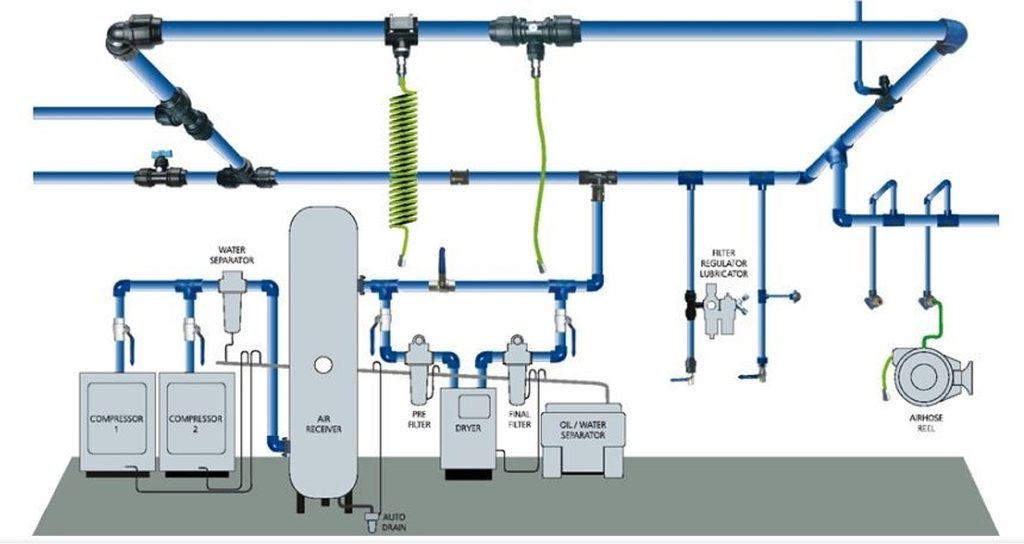
A fixed installation may require:
- A water separator.
- An air receiver with an automatic condensate drain.
- A pre-filter.
- A suitable compressed-air dryer.
- A final filter.
- Additional oil or water separation where required.
- Appropriate pressure regulation and monitoring at the point of use.
The exact configuration depends on the compressor, air quality, ambient conditions and equipment manufacturer’s requirements.
Not always. A water separator removes liquid water droplets, but it does not remove all water vapour. Where a low dew point is required, an appropriately sized compressed-air dryer may be necessary.
An air receiver stores compressed air and can help accommodate short-term variations in demand. It also provides an opportunity for condensate to collect and be drained. However, it cannot compensate indefinitely for a compressor that delivers insufficient air.
Hose reels and coiled hoses can introduce pressure losses, particularly when the internal diameter is small or the hose is long. Use hoses, couplings and fittings with suitable internal diameters and pressure ratings. Follow the blaster manufacturer’s installation recommendations.
Do not add lubrication automatically. Follow the specific equipment manufacturer’s instructions. Additional oil can contaminate the air supply and may be unsuitable for some applications, particularly in food production, electronics and other contamination-sensitive environments.
4. Selecting the Correct Cleaning Pressure
23. What working pressure should I use for industrial cleaning?
The appropriate pressure depends on the contamination, surface material, nozzle and equipment. The article gives 7–10 bar (100–150 psi) as a typical starting range for industrial equipment. Confirm the permissible range for your particular blaster and application.
24. What pressure is suitable for electrical and electronic equipment?
The article suggests approximately 2–5 bar (30–70 psi) as an indicative range. Always isolate equipment where required, follow electrical safety procedures and assess the sensitivity of components before cleaning.
25. What pressure should I use for plastic injection molds?
The article suggests approximately 7–12 bar (100–180 psi) for plastic and rubber molds. The correct setting depends on the mold material, contamination, geometry and equipment limitations. Test carefully and follow the manufacturer’s guidance.
26. What pressure is suitable for food and beverage equipment?
The article suggests approximately 4–8 bar (60–120 psi). Actual settings must be selected according to the surface, contamination and equipment requirements. Follow the site’s food safety, hygiene and contamination-control procedures.
27. What pressure should I use for historical buildings and delicate surfaces?
The article suggests approximately 3–6 bar (40–90 psi) for historical restoration. Start conservatively, test a small inconspicuous area and check for surface damage before proceeding.
28. Can dry ice blasting remove paint, epoxy and resin?
Yes. Dry ice blasting can remove certain coatings, adhesives, sealants and resin residues. The article gives a broad indicative range of approximately 8–17 bar (120–250 psi), but this must not be treated as a universal setting. Confirm that the selected blaster, hoses, fittings and air supply are rated for the intended operating pressure.
29. Should I always use the highest possible pressure?
No. Higher pressure is not automatically better. Excessive cleaning intensity may damage sensitive surfaces or components. Start with a suitable low setting, evaluate the result and increase pressure only as needed and within the equipment’s approved limits.
5. Installation and Practical Planning
30. How much space is required for a compressor and dry ice blaster?
The compressor may be substantially larger than the blaster. The article describes mobile compressors approximately 2.7–3.3 metres long and 1.33–1.75 metres high. Confirm the actual dimensions of the selected equipment and allow sufficient space for access, ventilation, maintenance and safe operation.
31. Can a long compressed-air line reduce cleaning performance?
Yes. Long lines, small internal diameters, restrictive couplings and bends can cause pressure losses. Design the installation to maintain the required pressure and airflow at the blaster during operation.
32. Why does the compressor need to be sized for continuous operation?
Dry ice blasting can create a sustained demand for compressed air. The compressor must maintain sufficient delivery during the intended operating period, rather than merely reaching the required pressure when the system is idle.
33. What should I check before starting a dry ice blasting job?
Check that:
- The compressor can deliver the required air volume at the required pressure.
- The electrical supply is suitable and safely installed.
- Air hoses and fittings are correctly rated and securely connected.
- The air supply is clean and sufficiently dry.
- The dry ice blaster is configured for the intended nozzle and application.
- Required PPE, ventilation and CO₂ safety measures are in place.
- The cleaning pressure has been selected for the surface and contamination.
6. Troubleshooting and Performance
34. Why is my dry ice blaster not cleaning effectively?
Possible causes include insufficient air pressure, inadequate air volume, unsuitable nozzle selection, incorrect pellet feed, unsuitable cleaning settings or contamination that requires a different approach. Check the air supply under operating conditions before changing the equipment settings.
35. Why does the pressure drop when I start blasting?
The compressor may be unable to supply the required volume, or the installation may have excessive pressure losses. Check the compressor’s delivered air capacity, hose diameter, couplings, filters, regulators and pressure measurements while blasting.
36. Why is the dry ice pellet flow inconsistent?
Possible causes include moisture or contamination in the air supply, irregular pellet quality, incorrect feed settings or a blockage in the feeding system. Check the air preparation system and follow the equipment’s troubleshooting instructions.
37. How can I increase cleaning speed?
First confirm that the compressor supplies adequate air volume at the correct pressure. Then review nozzle selection, pellet feed rate, blasting distance, angle and cleaning technique. Increasing air volume can improve productivity where the nozzle and application can make effective use of it.
38. How can I reduce compressed-air consumption?
Use a nozzle and operating pressure appropriate for the task, eliminate air leaks, avoid unnecessary restrictions in the air line and select a blaster configuration suited to the available compressor. Do not reduce air supply below the minimum required for stable operation.
39. How often should I maintain the air preparation system?
Follow the compressor, dryer, filter and blaster manufacturers’ maintenance schedules. Regularly inspect filters, drains, hoses, couplings and condensate management equipment. Replace filter elements and service the dryer as specified by the manufacturer.
Key Principle
The compressor and air supply are fundamental parts of every dry ice blasting system. Correct pressure, sufficient air volume, suitable electrical supply and clean, dry air help the blaster deliver consistent cleaning performance. Always verify operating conditions against the technical specifications of the selected equipment.